Researcher craft & identity
Future of the researcher role
64 indexed claims · 30 guests · peaked 2025-Q3
Overview
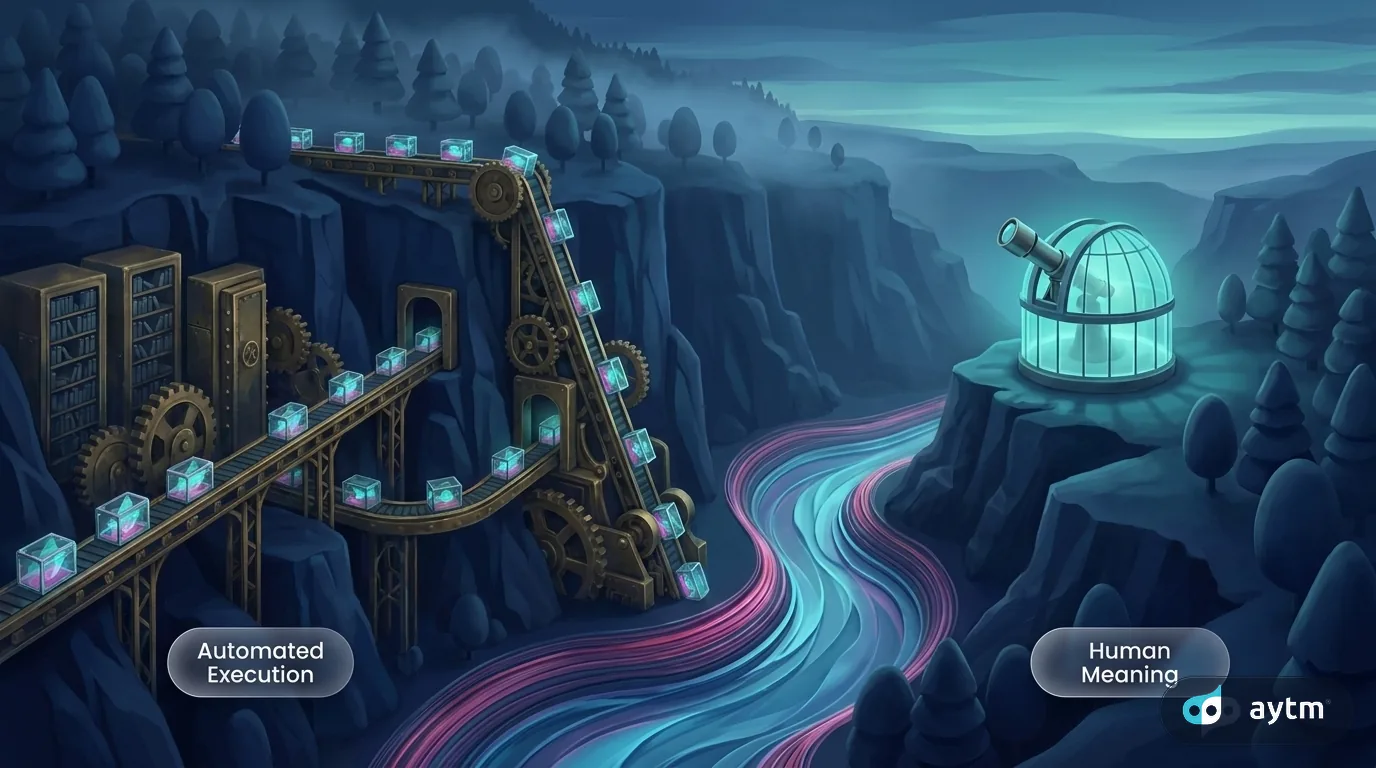
The future of the researcher role is, by some distance, the most contested terrain across these podcast episodes. At its center sits an inversion: as AI democratizes the mechanics of research — drafting surveys, moderating interviews, synthesizing themes — the profession's durable value shifts upstream, toward interpretation, judgment, and strategic partnership. But the conversations refuse a tidy resolution. Several guests argue that automation will not merely transform the role but compress the number of people doing it, demanding that survivors outperform an LLM on every dimension that matters. Against that backdrop, a second fault line opens around identity: what it means to call yourself a researcher when question-writing is being automated, when 'people talking' was always a smaller part of the craft than it felt, and when the title is increasingly granted without the underlying discipline it implies.
From the corpus
- A plausible near-future model of synthetic data is not LLM-generated mock respondents but AI assistants (Siris) acting as synthetic interpreters of real human telemetry — querying our assistants becomes more reliable than querying us directly, because they will know our likely behavior better than we can articulate it. — Lev Mazin, Ep. 24 ·
cl-lev-solo-016 - AI will compress insights timelines and surface themes humans cannot see by hand, but the consumer plug — primary research, multi-data-point integration, the human deciding which question to ask — does not go away; AI is going to be how researchers do it faster, not what gets done instead of researchers. — Kim Duncan, Ep. 14 ·
cl-kim-duncan-021 - A practitioner can apply market-research listening discipline to their own life: spotting a gap (anxiety journals dominated by 'rainbows and butterflies' aesthetics that didn't fit users like her), validating with therapists, and building product is the same craft applied to a personal problem. — Ashley Hopkins, Ep. 12 ·
cl-ashley-023 - The MSMR degree will remain valuable over the next five-to-ten years not because of any specific technology, but because the foundational requirements — analyzing data, thinking through problems, communicating effectively with humans — do not change as the industry reorganizes around AI. — Don DeVeaux, Ep. 18 ·
cl-don-deveaux-019 - The future identity of insights professionals is as internal strategy consultants who proactively understand business problems, not order-takers who execute a research brief on demand — 'I do internal strategy insights consulting for my company' is how the role should be introduced. — Michael Nevski, Ep. 26 ·
cl-michael-nevski-016 - Data scientists and analysts traditionally spent about 60% of their time pulling data and only 20% generating insights; AI flips that ratio, transforming the role from data puller to strategic adviser — an 'insight architect' who designs AI-driven workflows and refines model output. — Saket Kumar, Ep. 4 ·
cl-saket-kumar-009 - Insights work can no longer rely on hindsight or real-time alone; foresight has become the center of gravity, and every insights professional must now operate as a futurist — even though the accelerating pace of change makes 5- and 10-year planning nearly impossible. — Shanon Adams, Ep. 49 ·
cl-50th-009 - The most exciting evolution of strategic insights is using AI-augmented analytical and role-play simulation to construct alternate futures and starting points — sorting hundreds of scenarios down to the five or ten that matter is a perfect use case for the new tools. — Christopher Khoury, Ep. 47 ·
cl-christopher-khoury-019
Contributing guests
Episodes in Future of the researcher role
- aytm 50th Episode — Year-in-Review with Lev Mazin and Shanon Adams — Ep. 49 · Mar 3, 2026
- Christopher Khoury — Credibility, Cross-Training, and the Aircraft-Carrier-Meets-Speedboat of Health Insights — Ep. 47 · Feb 17, 2026
- The Gig Economy, Affluent Consumers, and What They Mean for Brands — Ep. 26 · Sep 16, 2025
- Scaling Consumer Insights: Design Thinking, Empathy, Tech & Analytics in Action — Ep. 24 · Sep 2, 2025
- From Classroom to Boardroom: Don DeVeaux on Training the Next Gen of Researchers — Ep. 18 · Jul 22, 2025
- Beyond Demographics: Redefining Flavor Segmentation with Kim Duncan — Ep. 14 · Jun 24, 2025
- Ashley Hopkins — Building Insights From Scratch: Listening Tours, Sponsors, and the Founder Mentality — Ep. 12 · Jun 10, 2025
- Saket Kumar — From Data Pullers to Insight Architects: Gen AI in Enterprise Analytics — Ep. 4 · Mar 25, 2025
See Researcher craft & identity mapped across all quarters →