Researcher craft & identity
Inclusive research / diverse perspectives
25 indexed claims · 7 guests · peaked 2026-Q1
Overview
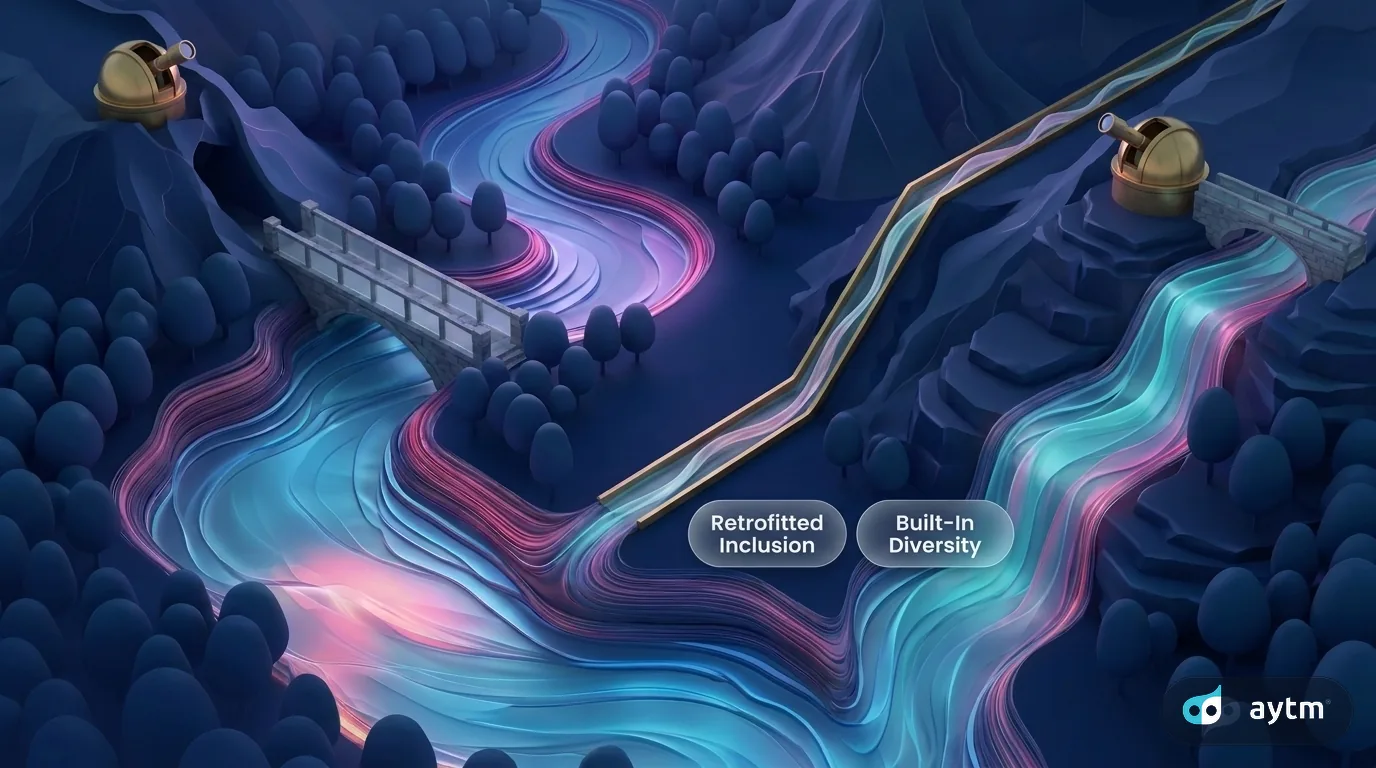
These podcast conversations make a consistent argument: exclusion is never accidental — it is designed in. Across episodes spanning consumer insights, education reform, and accessibility advocacy, guests return to a core tension between inclusion as afterthought and inclusion as method. Whether the subject is older adults stripped of product agency, neurodiverse researchers underutilized by teams that reward conformity, or surveys still inaccessible to people with disabilities, the structural failure is the same: those most valuable to the research process are added at the end, if at all. The editorial center of gravity is a reframe: difference is not a design problem to be solved but a signal worth pursuing. Guests argue that cognitively diverse teams outperform, that cross-disciplinary hires break category orthodoxy, and that designing for the margins produces better outcomes for everyone — the curb-cut principle applied to knowledge work.
From the corpus
- The most high-functioning research teams Louisea has worked on were the most cognitively diverse — mixing neurodivergent and neurotypical members, varied experience levels — because everyone's strengths complemented each other and the shared goal was letting the customer win, not letting anyone's idea win. — Louisea Hudson, Ep. 15 ·
cl-louisea-hudson-009 - The industry has a long way to go on inclusivity in research design because it still thinks about it in black-and-white terms; true inclusivity means recruiting for diverse cognitive styles — expressive people for emotional mapping, journalers for diary studies — not just demographic checkboxes. — Louisea Hudson, Ep. 15 ·
cl-louisea-hudson-012 - Researchers must constantly remind stakeholders that they are not always the customer; building empathy for audiences who are underserved or who look and think differently is how you disrupt markets, because the way to disrupt any market is to make products more accessible. — Louisea Hudson, Ep. 15 ·
cl-louisea-hudson-013 - Young researchers who think differently should lean into their differences rather than conforming; being different is what makes them unique and allows them to read the data in ways no one else will — this is their superpower, no matter how painful it feels at the start. — Louisea Hudson, Ep. 15 ·
cl-louisea-hudson-017 - LEGO Serious Play lowers participants' barrier to contributing because the abstractness of the bricks makes it visibly impossible for there to be a single right answer, removing the social pressure that suppresses honest input in verbal-first research. — Garret Westlake, Ep. 44 ·
cl-garret-westlake-004 - Designing for older adults at the end of the product development cycle is like inviting someone to a party and putting them in a separate room — they will leave; older adults must be included in the design process from the beginning to feel authentic. — Brittne Kakulla, Ep. 45 ·
cl-brittne-019 - Researchers from journalism, political science, and economics backgrounds make insights work more meaningful precisely because of the difference they bring; background variety is a structural strength of the field, not a recruiting awkwardness. — Charitie Dantis-Gayo, Ep. 42 ·
cl-charitie-dantis-gayo-004 - If knowledge work were only about producing the right answer, humans would already be obsolete; what justifies human contribution is the how, the context, the interconnectedness, and the diversity of perspective that AI cannot supply. — Garret Westlake, Ep. 44 ·
cl-garret-westlake-006
Contributing guests
Episodes in Inclusive research / diverse perspectives
- Brittne Kakulla — Why Older Adults Aren't Behind on Tech (They're Selecting Better) — Ep. 45 · Feb 3, 2026
- Why LEGO belongs in market research with Garret Westlake — Ep. 44 · Jan 27, 2026
- Charitie Dantis-Gayo — Nonlinear Paths, Hiring for Will, and Bringing the Human Back to Insights — Ep. 42 · Jan 13, 2026
- The art and science of innovation: Why mixed methods drive better results — Ep. 15 · Jul 1, 2025
See Researcher craft & identity mapped across all quarters →