Researcher craft & identity
Empathy in research
16 indexed claims · 10 guests · peaked 2025-Q2
Overview
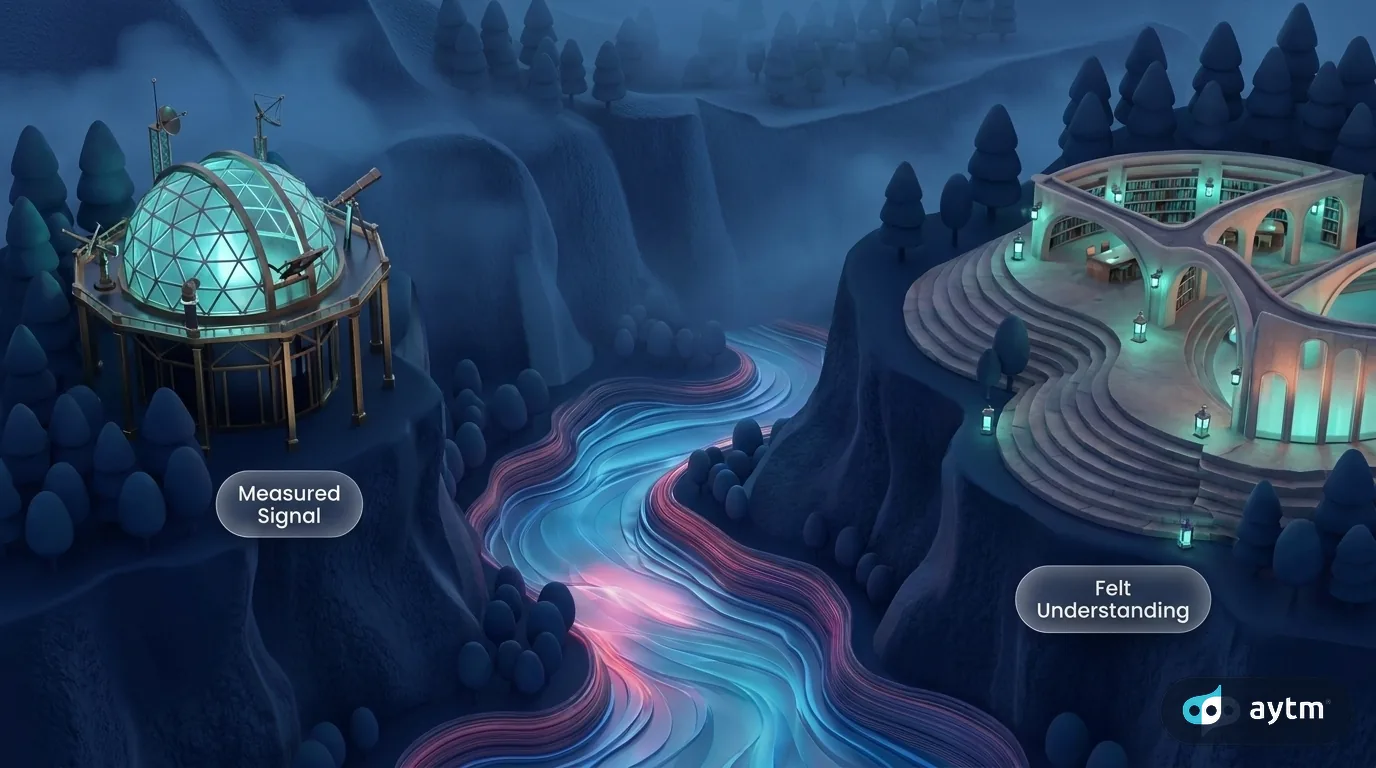
Across these podcast episodes, empathy in research proves to be a professional mandate with sharp edges — not a personality trait but an orientation that must be actively aimed. The guests map a range far wider than most practitioners acknowledge: empathy owed to survey respondents (even economically desperate fraud-risk ones), to stakeholders whose projects may quietly end when a finding lands, and to underserved audiences whose exclusion defines the next market disruption. Several voices reclaim the term from buzzword fatigue, arguing it is the origin story of research careers and the irreducible thing AI cannot replicate. The central tension: whether empathy is a learnable technique or an identity forged through cultural navigation, neurodivergent wiring, and immersive fieldwork — and what it means that machines are closing the measurement gap while the feeling gap remains wide open.
From the corpus
- Empathy — understanding a client's pressures before they have to articulate them, approaching with lower-cost faster solutions, asking relevant questions not to sell a research campaign but to show genuine understanding — is the most essential and most underrated skill for researchers seeking influence. — Laurie Demeritt, Ep. 50 ·
cl-laurie-demeritt-028 - Complexity theory complements (does not replace) the scientific method by encouraging researchers to first assess how knowable and controllable a problem actually is, and to lead with empathic understanding when systems are not fully knowable rather than defaulting to a hypothesis-and-experiment frame. — Tanya Pinto, Ep. 5 ·
cl-tanya-pinto-018 - Researchers should apply the same empathy to survey respondents that they apply to the consumers they are studying — translating questions into the respondent's language and generation, and remembering that some bad actors are economically desperate humans rather than fraud-bots. — Shanon Adams, Ep. 49 ·
cl-50th-007 - Researchers must constantly remind stakeholders that they are not always the customer; building empathy for audiences who are underserved or who look and think differently is how you disrupt markets, because the way to disrupt any market is to make products more accessible. — Louisea Hudson, Ep. 15 ·
cl-louisea-hudson-013 - Customer researchers are not just data keepers; they are the voice of the customer — the people who bring customer stories and pain points to life — and they must fight for the customer even when it feels like an uphill battle. — Louisea Hudson, Ep. 15 ·
cl-louisea-hudson-004 - Quantitative results give a level; the depth of disappointment or elation in respondents' actual feelings is something AI does not yet read empathetically — that empathy gap is what keeps the human researcher in the loop. — Charlie Grossman, Ep. 34 ·
cl-charlie-grossman-023 - Empathy applies as much to stakeholders receiving an insight as to the customers being researched; an insight may quietly mean a project or a team is being shut down, and the messenger should account for that. — Amberly Miller, Ep. 37 ·
cl-amberly-004 - An ADHD diagnosis recontextualized traits that felt different — surfacing non-obvious connections, hyper-empathy, reading body language during interviews — as researcher superpowers, not deficits. — Louisea Hudson, Ep. 15 ·
cl-louisea-hudson-007
Contributing guests
Episodes in Empathy in research
- Why food consumers say one thing and do another with Laurie Demeritt — Ep. 50 · Mar 10, 2026
- aytm 50th Episode — Year-in-Review with Lev Mazin and Shanon Adams — Ep. 49 · Mar 3, 2026
- Amberly Miller — Turning Curiosity Into Confidence: UX Research as Strategic Partnership at Prudential — Ep. 37 · Dec 2, 2025
- Charlie Grossman — Stop chasing speed: build consistency that predicts outcomes — Ep. 34 · Nov 11, 2025
- The art and science of innovation: Why mixed methods drive better results — Ep. 15 · Jul 1, 2025
- Tanya Pinto — Human at the Center: Empathy, AI, and the Researcher's Discernment — Ep. 5 · Apr 15, 2025
See Researcher craft & identity mapped across all quarters →