AI & technology
AI as augmentation
128 indexed claims · 43 guests · peaked 2025-Q2
Overview
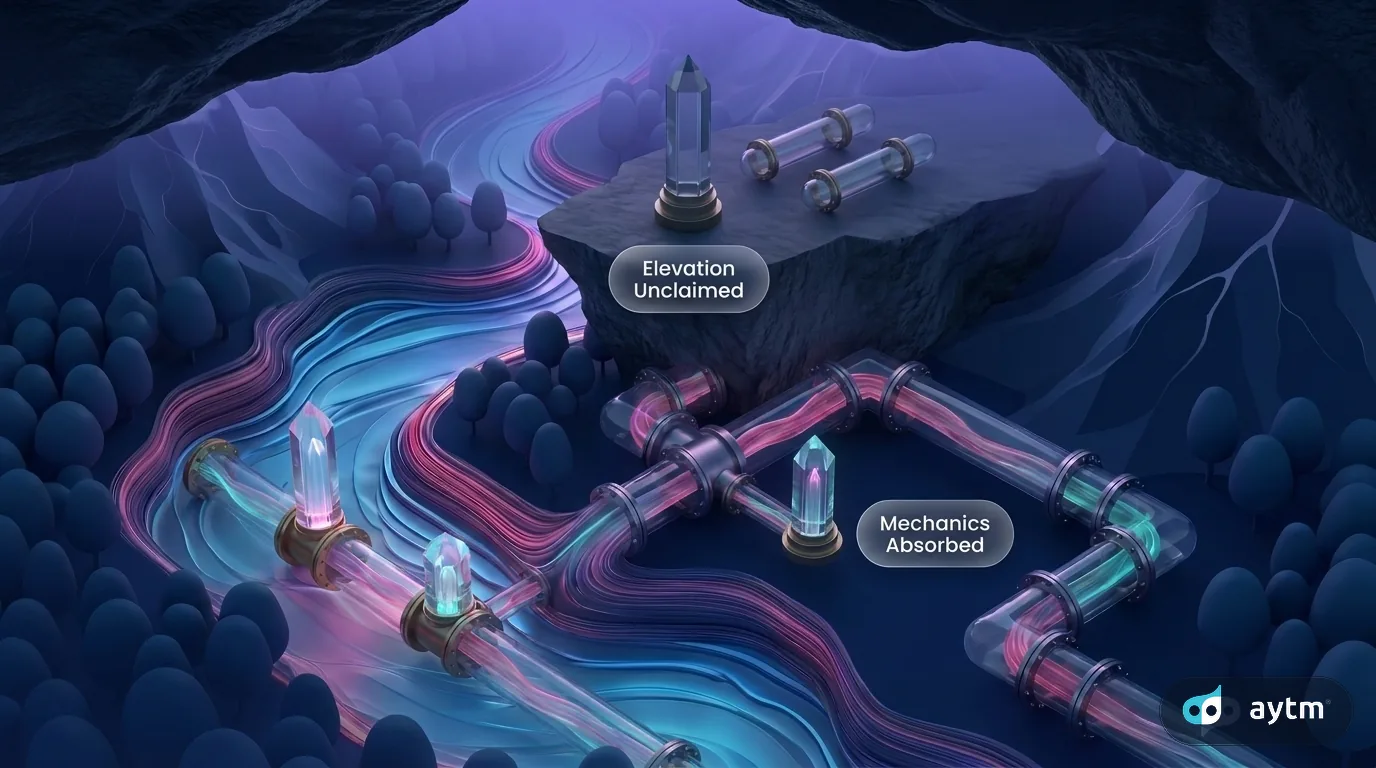
Across seven quarters and 48 voices, these podcast conversations converge on a single organizing thesis: AI does not replace the researcher — it reassigns them. The chores vanish (open-end coding that took weeks now takes minutes; 30-hour competitive assessments collapse to five), and what remains is the work that was always the point: interpretation, influence, and the irreducibly human act of making an organization care about a finding. The consensus frays at the edges. Guests disagree sharply about whether that reassignment elevates or hollows out the profession, who stays in the room when AI handles more, and how much wisdom the industry has accumulated about where the tools break. The dominant tension is not skeptic versus optimist — it is between practitioners who see augmentation as the path to strategic influence and those who warn that adoption is outpacing judgment.
From the corpus
- AI use in research falls along a three-level intervention spectrum: no intervention (client query → automated answer; enables retrospective ROI tracking on tracking studies), moderate intervention (current state — AI gets you almost there on specific business cases), and full engagement (seismic shifts like tariffs or the iPhone where AI has no context and humans must step in). — Dave Ritter, Ep. 16 ·
cl-dave-ritter-015 - AI can draft a starter questionnaire but tends to generic output without specific prompting, and it does not yet detect bias in the questions it generates — including order effects (asking how healthy fries are before asking how much you like them inflates the healthiness weight on liking) — so survey-design training is still required. — Ernest Baskin, Ep. 48 ·
cl-ernest-baskin-010 - The industry's enthrallment with AI has crowded out qualitative co-presence — focus groups, interviews, ethnographies, shop-alongs; the start move is to bring those methods back, because in-person observation reveals decision behavior (price-checking on phone in store, Netflix as background noise) that no synthetic dataset captures. — Charitie Dantis-Gayo, Ep. 42 ·
cl-charitie-dantis-gayo-023 - AI will compress insights timelines and surface themes humans cannot see by hand, but the consumer plug — primary research, multi-data-point integration, the human deciding which question to ask — does not go away; AI is going to be how researchers do it faster, not what gets done instead of researchers. — Kim Duncan, Ep. 14 ·
cl-kim-duncan-021 - Early-career professionals lost foundational years of in-person relationship-building during COVID; AI emerged in that window as a substitute for asking another human, which compounds the deficit — managers must deliberately re-teach interpersonal skills, including knowing when not to ask the chatbot. — Charitie Dantis-Gayo, Ep. 42 ·
cl-charitie-dantis-gayo-017 - The data quality problem resembles the antivirus industry's problem: the work is never done because new threats and bad actors emerge continuously, and AI is now both the attack vector and a source of defenses; the same technology that erodes data quality can be used to spot and improve it. — Shanon Adams, Ep. 49 ·
cl-50th-006 - The MSMR degree will remain valuable over the next five-to-ten years not because of any specific technology, but because the foundational requirements — analyzing data, thinking through problems, communicating effectively with humans — do not change as the industry reorganizes around AI. — Don DeVeaux, Ep. 18 ·
cl-don-deveaux-019 - Data scientists and analysts traditionally spent about 60% of their time pulling data and only 20% generating insights; AI flips that ratio, transforming the role from data puller to strategic adviser — an 'insight architect' who designs AI-driven workflows and refines model output. — Saket Kumar, Ep. 4 ·
cl-saket-kumar-009
Contributing guests
Episodes in AI as augmentation
- aytm 50th Episode — Year-in-Review with Lev Mazin and Shanon Adams — Ep. 49 · Mar 3, 2026
- When the data is right but the decision is wrong with Ernest Baskin — Ep. 48 · Feb 24, 2026
- Charitie Dantis-Gayo — Nonlinear Paths, Hiring for Will, and Bringing the Human Back to Insights — Ep. 42 · Jan 13, 2026
- From Classroom to Boardroom: Don DeVeaux on Training the Next Gen of Researchers — Ep. 18 · Jul 22, 2025
- Anticipating the Future: Dave Ritter on AI, Analytics, and Retail Insights at Walmart — Ep. 16 · Jul 8, 2025
- Beyond Demographics: Redefining Flavor Segmentation with Kim Duncan — Ep. 14 · Jun 24, 2025
- Saket Kumar — From Data Pullers to Insight Architects: Gen AI in Enterprise Analytics — Ep. 4 · Mar 25, 2025